

How to Resolve Mechanical Jamming of Automotive Seat Slides?
How to Resolve Mechanical Jamming of
Automotive Seat Slides?
Solutions for Mechanical Jamming of
Automotive Seat Slides (Scenario-Based + Operation Guide)
Mechanical jamming is the most common fault
of automotive seat slides (accounting for approximately 45%). Its resolution
must follow the logic of "First Diagnosis & Localization →
Scenario-Based Handling → Effect Verification → Preventive Maintenance,"
balancing safety and practicality. Below is a systematic solution targeting
different causes, covering tool preparation, operation steps, technical
parameters, and precautions, suitable for both private car owners for
self-inspection and maintenance personnel for professional handling.
I. Pre-Diagnosis: Quickly Locate the
Cause of Jamming
Before taking action, quickly identify the
root cause of jamming in 3 steps to avoid blind operations:
Basic Observation:
-
Check for obvious foreign objects (e.g., coins, sand, tangled
wiring harnesses) under the seat rails;
-
Manually push the seat to feel if the jamming is "high
resistance throughout the stroke" or "localized jamming"
(localized jamming is mostly due to foreign objects or structural
deformation; high resistance throughout may indicate lubrication failure
or rust).
Functional Testing:
-
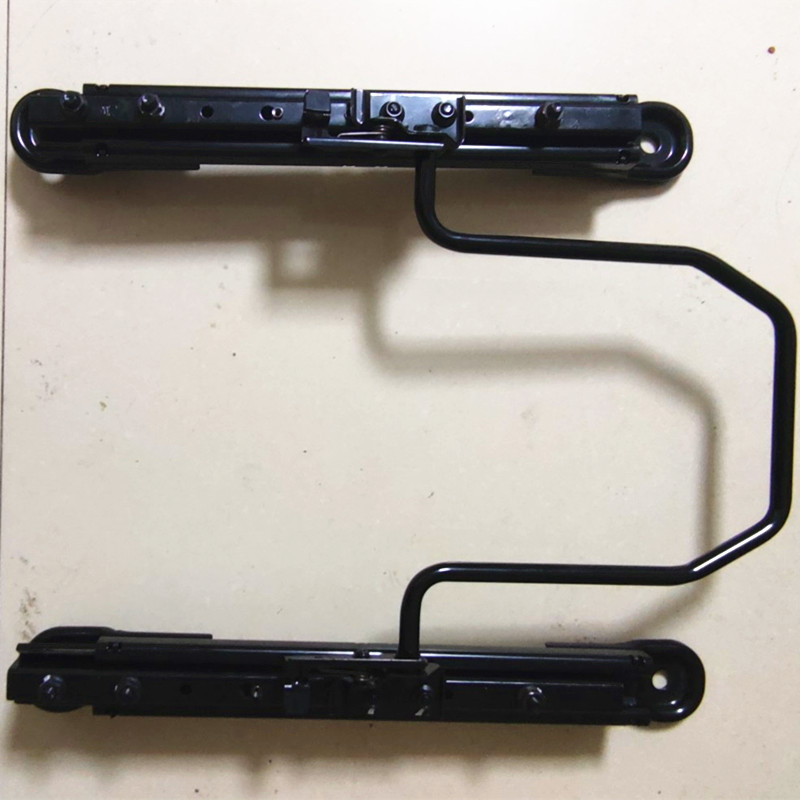
Manual slides: After unlocking, push the seat. If the unlocking
force is abnormally high (exceeding the standard value of 55N) or jamming
persists after unlocking, the locking mechanism may be jammed;
-
Electric slides: If the motor makes noise but the seat does not
move, first inspect the fuse (usually marked "SEAT" or
"POWER SEAT"). If the fuse is intact, mechanical jamming is
likely causing motor overload.
Visual Inspection:
-
Observe the rail surface for rust, scratches, or bending
deformation;
-
Check if the seat slide fixing bolts (usually 4-6 pieces) are
loose and if the brackets have collision marks.
II. Scenario-Based Solutions (In Order
of Increasing Operation Difficulty)
Scenario 1: Jamming Caused by Foreign
Object Intrusion (Most Common, 60% of Jamming Faults)
Core Logic:
Remove foreign objects from rail gaps and the locking mechanism to eliminate
movement obstacles.
Tools Required:
-
Basic tools: Vacuum cleaner (with flat nozzle), soft brush
(e.g., toothbrush), tweezers, compressed air (optional, pressure ≤0.5MPa);
-
Auxiliary tools: Flashlight (to illuminate rail gaps), cleaning
cloth (dampened with a small amount of anhydrous ethanol).
Operation Steps:
-
Seat Reset: Adjust the seat to the
farthest forward or backward position to expose the full length of the
rails (ensure rail gaps are fully visible);
-
Preliminary Cleaning: Use a soft
brush to remove surface dust and particles along the length of the rails,
focusing on the roller/ball area and the locking mechanism;
-
Deep Foreign Object Removal:
-
Aim the flat nozzle of the vacuum cleaner at rail gaps to suck
out deep sand or small foreign objects;
-
If there are tangled wiring harnesses or hair, gently pull
them out with tweezers (avoid pulling to prevent harness damage);
-
If foreign objects are stuck (e.g., coins between the lock
tongue and tooth grooves), gently pry them out with a flathead
screwdriver (use moderate force to avoid scratching the rails or damaging
the lock tongue);
-
Residue Cleaning: Wipe the rail
surface with a cloth dampened with a small amount of anhydrous ethanol to
remove oil stains or beverage residues (do not use gasoline or corrosive
cleaners).
Verification Standards:
-
The seat slides smoothly throughout the stroke without jamming
when pushed manually;
-
Locking/unlocking actions are flexible with no sense of
obstruction from foreign objects.
Scenario 2: Jamming Caused by
Lubrication Failure (Accounting for ~30%)
Core Logic:
Supplement suitable grease to reduce dry friction between metal components.
Key Prerequisites:
-
Grease Selection: Must use specialized grease for
automotive seat slides (recommended type: Lithium-based grease
NLGI Grade 2, temperature resistance range -40℃~120℃, e.g., Mobil 1
Synthetic Grease). Do not use ordinary butter (prone to caking and poor
high-temperature resistance);
-
Pre-Cleaning: Complete rail cleaning as per Scenario 1 first.
Otherwise, grease will mix with foreign objects to form sludge, worsening
jamming.
Tools Required:
-
Grease (50g is sufficient for a single operation), grease gun
(or disposable grease syringe for precise application), gloves.
Operation Steps:
-
Application Areas: Focus on the
following 3 key areas (avoid omission):
-
Inner sliding surface of the rails (apply evenly, thickness
0.5~1mm);
-
Rollers/balls and cages (each roller surface must be covered
with grease to avoid local grease deficiency);
-
Locking mechanism (lock tongue, tooth grooves, and connection
points of the return spring; apply a small amount only to prevent oil
accumulation leading to locking failure);
-
Uniform Distribution: After
application, slide the seat forward and backward 3~5 times to allow grease
to evenly cover all contact surfaces during movement;
-
Excess Cleaning: Wipe off excess
grease on the rail surface with a cloth (to avoid dust adsorption).
Technical Parameters:
-
Lubrication Cycle: 6~12 months or 10,000km for ordinary
vehicles; 3~6 months for high-frequency use vehicles (e.g., ride-hailing
cars, taxis); shortened to 3 months for coastal humid areas.
Verification Standards:
-
Seat sliding resistance ≤15N (for manual slides, testable with
a spring scale);
-
No "squeaking" friction noise during sliding, and
adjustment is smooth.
Scenario 3: Jamming Caused by Structural
Deformation/Component Wear (Accounting for ~10%)
Core Logic:
Repair minor deformation, replace worn components, and restore rail structural
accuracy.
Precautions:
-
If deformation is severe (e.g., rail bending exceeding 1mm,
broken cage) or component wear exceeds limits (e.g., roller diameter wear
≥0.3mm), it is recommended to directly replace the slide assembly (to
avoid safety risks after repair);
-
Basic mechanical maintenance skills are required, or operation
by professional technicians.
Tools Required:
-
Basic tools: Torque wrench (torque range 0~50N・m), hexagon socket wrench, box-end wrench, level;
-
Specialized tools: Rail straightening pliers (small hydraulic
pliers for minor deformation correction), micrometer (for wear
measurement).
Operation Steps:
-
Seat Removal (for severe
jamming requiring disassembly):
-
Disconnect the negative terminal of the vehicle battery (to
prevent accidental activation of electric slides);
-
Use a torque wrench to remove the seat base fixing bolts
(standard torque: 18~22N・m, refer to the
vehicle maintenance manual);
-
Gently lift the seat and disconnect the power wiring harness
of electric slides (manual slides can be directly removed);
-
Deformation Correction:
-
Use a micrometer to measure rail bending. If the bending
amount ≤0.5mm, slowly straighten with rail straightening pliers (operate
with small force multiple times to avoid fracture due to
over-correction);
-
After correction, use a level to check rail flatness, ensuring
an error ≤0.2mm/m;
-
Worn Component Replacement:
-
If rollers/balls are excessively worn or cages are deformed,
replace with roller assemblies of the same model (must match slide
specifications, e.g., 16mm diameter rollers correspond to specific slide
models);
-
If the locking mechanism is jammed (e.g., rusted lock tongue,
fatigued return spring), replace the locking mechanism assembly (low
cost, approximately 50~200 RMB/set);
-
Reinstallation:
-
Install the seat in the reverse order of removal, ensuring
alignment between the slides and the vehicle body connection bracket
(deviation ≤0.3mm);
-
Tighten bolts to the standard torque with a torque wrench to
avoid loosening;
-
For electric slides, reconnect the wiring harness and check
for good connector contact.
Verification Standards:
-
Seat sliding stroke meets design standards (e.g., long slide
stroke ≥250mm);
-
Locking mechanism engagement depth ≥2mm, with no loosening
after locking;
-
No motor overload noise during electric slide adjustment, and
current ≤5A (detectable with a diagnostic tool).
Scenario 4: Locking Mechanism Jamming
Due to Icing in Low-Temperature Environments (Special Scenario)
Core Logic:
Thaw the frozen area to avoid component damage caused by forced operation.
Operation Steps:
-
Gentle Thawing: Start the vehicle
and turn on the seat heating function (if available), or use a hair dryer
(low-temperature setting) to blow the locking mechanism area under the
seat for 10~15 minutes (do not use an open flame to avoid aging of plastic
components);
-
Auxiliary Unlocking: After thawing,
gently press the unlocking handle while slowly pushing the seat (avoid
violent operation to prevent lock tongue fracture);
-
Preventive Measures: After thawing,
supplement specialized low-temperature grease as per Scenario 2, or apply
anti-freeze grease (temperature resistance below -40℃) before winter.
III. Common Misconceptions and Safety
Precautions
-
Prohibit Violent Operation: Do not
kick the seat or hit it with heavy objects when jammed, as this may cause
rail deformation, locking mechanism fracture, or motor burnout;
-
Grease Selection Taboos:
-
Do not use liquid lubricating oil (prone to leakage and short
lubrication duration);
-
Do not use high-temperature grease (e.g., industrial gear
grease, which solidifies easily at low temperatures and worsens jamming);
-
Special Notes for Electric Slides:
-
Must disconnect the battery negative terminal before handling
to prevent wiring harness short circuits;
-
If the motor has activated overload protection (sudden stop
during adjustment), eliminate mechanical jamming first before restoring
power supply (to avoid motor burnout due to repeated power-on);
-
Professional Maintenance Boundary:
-
If the rail bends more than 1mm, the cage is broken, or the
lock tongue tooth surface wear ≥0.5mm, it is recommended to replace the
slide assembly (original equipment slide assembly price: manual slides
approximately 200~800 RMB, electric slides approximately 1000~3000 RMB);
-
If jamming persists after self-handling, or is accompanied by
locking failure or abnormal noise, take the vehicle to a 4S shop or
professional maintenance factory for inspection (to avoid missing safety
hazards).
IV. Preventive Maintenance Plan (Reduces
Jamming Rate by 90%)
-
Regular Cleaning: Clean rail
foreign objects with a soft brush + vacuum cleaner every 3 months to
prevent beverage or snack residues from falling under the seat;
-
Standardized Lubrication:
Supplement specialized grease according to the aforementioned lubrication
cycle, and appropriately shorten the cycle for coastal humid areas or
dusty road conditions;
-
Avoid External Impact:
-
Do not place heavy objects (e.g., toolboxes, mineral water
crates) under the seat to prevent rail extrusion;
-
Avoid colliding with the seat base when loading luggage, and
promptly inspect slides for deformation after accidents;
-
Winter Protection: After long-term
parking in northern winters, start the vehicle to preheat before adjusting
the seat (to avoid locking mechanism jamming due to icing).